
The Six-Session Suite
A professional development suite of 6 sequenced sessions designed to help you build a sustainable EPI program.
EPI is explicit teaching for the languages classroom.
If your school has invested in explicit teaching, retrieval practice, low-variance instruction or any of the cognitive science-informed frameworks shaping Australian education right now, you already understand the principles behind EPI. You just may not have seen them applied effectively to language learning.
EPI takes what we know about memory, processing and fluency development, and turns it into a clear, sequenced approach that languages teachers can actually use. Students hear, process, recycle and retrieve language repeatedly, until it becomes familiar enough to use with confidence.
No more guessing whether the lesson worked. No more wondering why students who can fill in a worksheet freeze the moment you ask them a question.
The goal is not to create perfect performers overnight. It is to build classrooms where language is recycled deliberately, success feels achievable, and teachers are not reinventing every lesson from scratch.
The Comprehensible Classroom PD suite is built for languages teams who want to move from theory to practice. Each session is hands-on, classroom-ready, and grounded in real lessons taught by a real teacher over a five-year EPI transition.
Schools can book individual sessions or the full sequence. The full suite is designed to be delivered fortnightly across a term, giving teachers time to try things between sessions and bring back questions. Most sessions run for two hours. The planning and sequencing session runs for three, because it is the one that ties everything together.
Who this is for:
Languages teachers wanting practical strategies that actually work in real classrooms
KLA leaders looking for greater consistency across teams
Schools beginning an EPI or explicit instruction transition
Teachers who are tired of students forgetting everything after the test
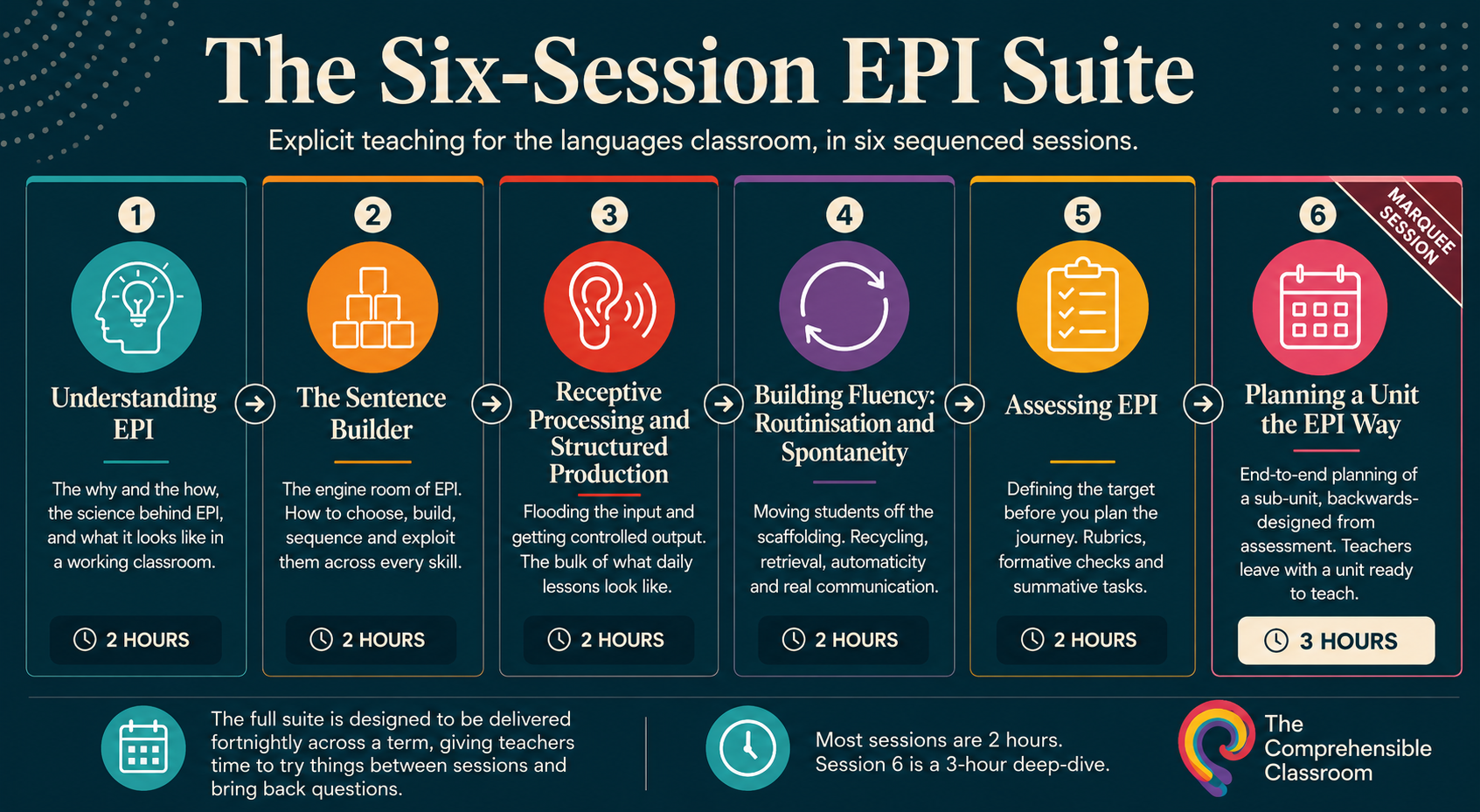
Understanding EPI
✳︎
The Sentence Builder
✳︎
Planning a Unit the EPI Way
✳︎
Receptive Processing
✳︎
Building Fluency
✳︎
Assessing EPI
✳︎
Understanding EPI ✳︎ The Sentence Builder ✳︎ Planning a Unit the EPI Way ✳︎ Receptive Processing ✳︎ Building Fluency ✳︎ Assessing EPI ✳︎
The why, the how, and what it looks like when it is working.
Before we touch a sentence builder or run a single dictation, we need to be on the same page about what EPI actually is and why it works. This session unpacks the cognitive science behind the approach, the full MARSEARS sequence at a glance, and the shift in classroom culture that makes the rest possible. Plenty of demonstration, plenty of "oh, that is what they mean" moments, and time to start mapping where your current program already fits and where the gaps are.
Teachers leave with a clear mental model of EPI, a shared vocabulary with their team, and an honest sense of what changing practice will involve.
Duration: 2 hours
The engine room of every EPI lesson.
If you only get one thing right, get this right. The sentence builder is the single most important resource in an EPI classroom, and most teachers using them are getting two thirds of the value out of them. This session covers how to choose, design and sequence sentence builders that actually work, how to exploit them across reading, listening, speaking and writing, and how to use them to embed pop-up grammar and pop-up pronunciation without breaking the flow of the lesson.
Teachers leave with a working sentence builder for their next unit, a clear sequence of tasks to run with it, and the confidence to stop reinventing the wheel every fortnight.
Duration: 2 hours
Most of what happens in a daily EPI lesson lives in these two phases. Students need to hear and read the target language many times before they can use it, and when they do start producing it, they need scaffolded, controlled tasks that build confidence before fluency. This session is a working tour of the high-yield tasks that make this happen: listening grids, narrow reading, sentence stealer, faulty echo, mind reader, running dictation, oral ping-pong, and the structured production tasks that bridge input and output without exposing students to the dreaded blank page.
Teachers leave with a working bank of tasks they can run tomorrow, and a clearer sense of how to sequence them across a lesson.
Duration: 2 hours
Getting students off the scaffolding and into real communication.
This is the phase most language programs never quite reach, and it is where the magic happens. Routinisation is the recycling engine that builds automaticity. Spontaneity is what you see when students use the language without props, without prompts, and without panic. This session covers retrieval practice across topics, interleaving, the 4-3-2 technique, marketplace, chain reaction, and the gradual removal of supports that takes students from "I can do this with the sentence builder" to "I can do this without it."
Teachers leave with a recycling plan, a set of fluency-building routines, and a realistic sense of how long this phase takes (longer than they think, and that is fine).
Duration: 2 hours
Defining the target before you plan the journey.
Assessment is the bit most EPI training quietly skips, and it is the bit schools need help with most. If your scope and sequence is now built around chunks, sentence builders and high-frequency structures, your assessment needs to follow. This session covers formative checks that genuinely inform the next lesson, summative tasks that reflect EPI principles rather than fighting them, student-facing and teacher-facing rubrics, and how to report on progress in a way that makes sense to parents, students and senior leadership. Crucially, it positions assessment where it belongs in backwards planning: as the thing you design first, so the unit knows where it is going.
Teachers leave with rubric templates, sample assessment tasks, and a clear approach to assessment that fits the way they are now teaching, and that they can plan toward in Session 6.
Duration: 2 hours
The session that ties everything together.
This is the big one. Three hours, hands on, end to end, and it sits at the end of the suite deliberately. Backwards planning is non-negotiable in EPI: you cannot sequence a unit until you know what fluency looks like at the end of it, what you are assessing, and how you will recycle the chunks that get you there. By now teachers have all of that. So we take a real unit you are about to teach and plan it together, working sentence builders, MARSEARS sequencing, recycling logic, formative checkpoints and assessment design woven through, lesson by lesson.
By the end of the session, every teacher in the room has a planned sub-unit they can teach next week, not a vague outline and a head full of ideas. This session also works beautifully as a departmental planning day, where the whole team leaves with shared, coherent planning for the term ahead.
Teachers leave with a fully planned sub-unit, a usable planning template, and a far clearer sense of what a good EPI unit looks like from start to finish.
Duration: 3 hours
PRICING
Straightforward pricing. No hidden fees, no surprise add-ons. If something is not listed, ask.

Get In Touch
If you're interested in working with The Comprehensible Classroom or have a question (or 5!), complete the form with a few details about what your your school is hoping to do and I will respond within two working days.
Your details are only used to respond to this enquiry. No mailing list, no automation, just a real reply from me